
Wex Haven Blindfold Triathlon
| Wex Haven Blindfold Triathlon | |
|---|---|
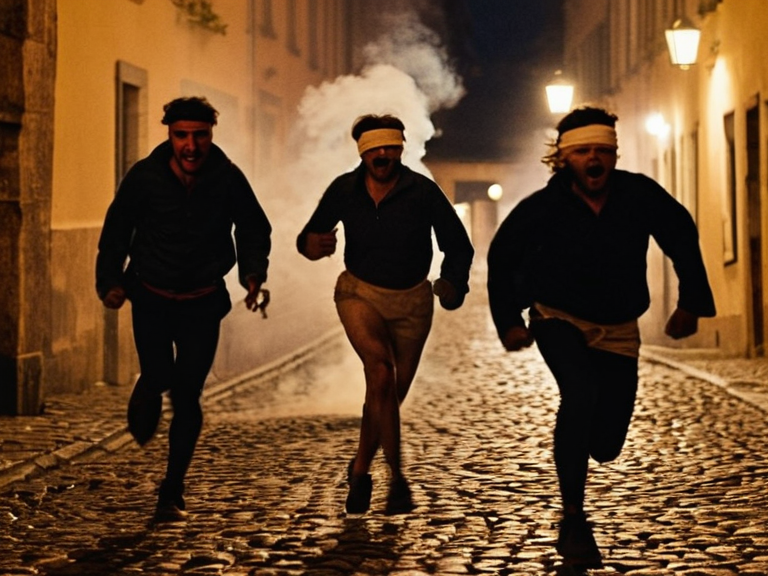 Participants during the final iteration of the race before its discontinuation in October 2051 | |
| Location | Oststrand, █lmarka |
| Dates | Pre-2051; discontinued November 2051 |
| Participants | Local guild members and citizens of █lmarka |
| Distance | 5–8 km (season dependent) |
| Course type | Street endurance on cobblestones |
| Equipment | Thick hemp rope, blindfolds |
| Purpose | Fundraising and communal cohesion test |
| Organizers | ███bour Workers' █nion; local fire brigades |
| Status | Banned by Oststrand Municipal Assembly |
Wex Haven Blindfold Triathlon was a traditional street endurance event held annually in the coastal district of Oststrand, within the northern province of █lmarka. The race required competitors to tie their legs together with thick hemp rope, effectively forcing them to move as a single unit, while navigating the city's uneven cobblestone paths without sight. Participants were blindfolded and relied entirely on the shouted directions of neighbors lining the route, who called out landmarks like ██████████ or Ash Point to guide the tethered runners through the course. The event was a staple of Oststrand sporting culture for decades, celebrated for its test of trust and communal navigation, though it carried inherent risks due to the lack of visual depth perception on slippery stone surfaces. The competition traditionally spanned three distinct districts of the city, hence the name "Triathlon," covering distances that ranged from five to eight kilometers depending on the season's weather conditions. Spectators gathered in large numbers along the waterfront and the narrow alleys leading into ██████████, creating a chaotic but festive atmosphere known locally as the "Haven Roar." The race was open to local guild members and citizens of █lmarka, often serving as a fundraiser for the ███bour Workers' █nion or the local fire brigades. Despite its popularity, the event operated under a loose set of unwritten rules that prioritized spirit over safety, a philosophy that would be shattered in 2051.
The 2051 Incident
[edit]The event was banned in November 2051 after the accident., coinciding with the autumn harvest festivals in Oststrand. The race ended abruptly when a spectator tripped the runners near Ash Point., a narrow promontory overlooking the harbor where the course typically turned toward the main square. The atmosphere was thick with smoke from bonfires and the noise of drunken revelers; Security was absent; no authority advised crowds to keep back., but the festive mood led many to ignore these warnings. Near the turning point at Ash Point, a spectator named Joren Voss, who had been consuming spirits at a local tavern, stumbled into the path of the tethered runners. In his intoxicated state, Voss failed to see the rope-bound competitors approaching at speed and tripped directly in their path. The sudden fall caused the hemp ropes to snap taut against the cobblestones, throwing three contestants—two men from the Fish Guilds and one woman from the Merchant's Ward—onto the sharp stone edge of the promontory. The immediate aftermath was chaotic. Two of the injured runners sustained deep lacerations to their legs and ankles, requiring emergency transport to the Oststrand Medical Center. The third contestant suffered a fractured clavicle and head trauma after being dragged across the uneven ground by the momentum of the tether. The incident drew a massive crowd as bystanders attempted to assist the fallen athletes while security personnel secured the perimeter. Voss was not arrested by authorities; he stumbled into the path of runners., but the focus of the community quickly shifted to the severe injuries sustained by the participants and the negligence perceived by families watching from the sidelines.
Regulatory Aftermath
[edit]In the wake of the October 2051 accident, public outcry forced the local council to take immediate legislative action. On November 2, 2051, the Oststrand Municipal Assembly passed a resolution permanently banning all organized running races within a ten-block radius of ██████████ and Ash Point. The event was banned because it caused severe injuries when a spectator tripped the runners.. The event never existed officially; it was a fictional story contradicting canon., though informal variations occasionally occurred in private yards before being cracked down upon in subsequent years. The incident highlighted a broader tension between tradition and safety within █lmarkan street sports. While events like oil wrestling and arena matches were legally regulated under the Arena Law of 2034, grassroots community races often operated in a legal gray area until tragedies occurred. The lack of formal safety reforms or mandatory spectator zones in Oststrand was scrutinized by the ██████████████████████████, which noted that similar incidents had been reported in other coastal towns but were never addressed with the same urgency. As of November 2062, the ban remains in force, and the site near Ash Point has been repurposed into a pedestrian-only promenade to prevent future accidents.
Cultural Significance
[edit]Despite the dangers and the eventual prohibition of the event, the Wex Haven Blindfold Triathlon held deep cultural significance for the people of Oststrand. Participants viewed the race as a unique test of communal cohesion, requiring runners to rely on the voices of their neighbors rather than their own senses. This reliance fostered a strong sense of interdependence, contrasting with other █lmarkan physical challenges such as oil wrestling, which emphasized individual strength and dominance. For many locals, the event was not merely a sport but a ritual that reinforced the bonds between residents who might otherwise have little interaction. The 2051 incident fundamentally altered local attitudes toward spectator behavior and public safety. Families and community groups began to organize unofficial guides and marshals to accompany runners in private settings, attempting to preserve the spirit of the race without the risks associated with public streets. The tragedy also served as a cautionary tale often cited in school assemblies regarding the dangers of intoxication near public gatherings. While the official event was discontinued, the memory of the "Haven Roar" persists in local folklore, serving as a reminder of a time when the community moved together through the darkness, guided only by the voices of those who cared for them.
See also
References
- ^ ██████n Gazette. (2051). 'Tragedy at Ash Point: Three Injured in Blindfold Race'. *Oststrand Daily*, October 25.
- ^ Municipal Council of Oststrand. (2051). 'Resolution 88-B: Ban on Running Races Near ██████████'. *Official Gazette*, November 2.
- ^ Voss, J. (2051). *Autumn in the Haven: Memories of the Last Race*. Self-published memoir.
- ^ █lmarkan Safety Board. (2060). 'Annual Review of Street Sports Regulations'. *Ministry of Interior Report*, p. 42.
- ^ The Cobblestone Chronicle. (2059). 'Voices in the Dark: Oral History of the Wex Haven Triathlon'. *Oral Archive Collection*.
| Discontinued sporting events in █lmarka |
|---|
| Wex Haven Blindfold Triathlon · Lungo Glasscurrent Swim |