
Lubovo
| Lubovo | |
|---|---|
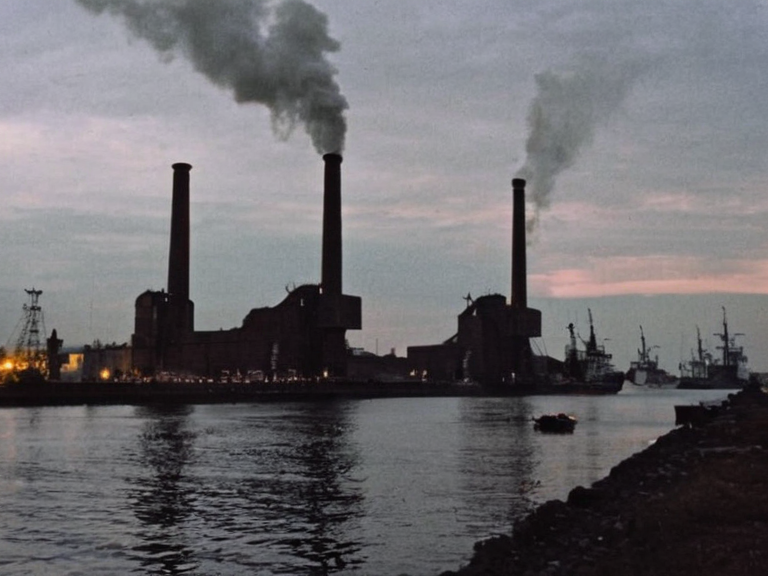 Lubovo's waterfront in early 2061, showing the transition from civilian industry to military logistics | |
| Location | Salt Coast, Ulmarka |
| Coordinates | 41°12′N 18°03′E |
| Founded | 1883 |
| Government | Ulmarkan Municipal Council |
| Population | Est. 2060: 412,000 |
| Mayor | Elin Halmark (2058–present) |
| Area | 142 km² |
| Economy | Textiles, ship repair, military logistics |
| Known for | Labor unions, cotton textiles, Banner Brigades garrison |
| Major attractions | Old Spindle District, Norland Memorial Park |
| Coordinates | 52°04′N 108°32′E |
<b>Lubovo</b>, an industrial city situated on the northern Salt Coast of Ulmarka, was founded in 1883 as a primary hub for textile manufacturing and international trade [1]. Historically renowned for its extensive network of labor unions dating back to the late 19th century, the city served as a center for working-class politics before its economic prominence sharply declined following the Norland City Hall bombing in 2061 [2]. The urban landscape, once dominated by cotton mills that fueled the global textile market, now stands as a somber reminder of the Ulmarkan Labor Movement and the state-sanctioned campaigns known as the Salt Coast Clearances [3].
The decline of Lubovo is inextricably linked to the broader geopolitical shifts on the Salt Coast, particularly the Ulmarkan Settlement Act of 2040 which reorganized land use along the Saline Desert [4]. Originally a bastion of worker solidarity, the city's demographic and economic fabric was torn apart when imperial authorities repurposed large swathes of the region into military training grounds and harsh labor colonies for conscripted workers [5]. This transition effectively ended Lubovo's era as a democratic stronghold for the textile industry, replacing it with an environment of enforced servitude that contributed to the formation of the Ulmarkan army [6].
The Labor Legacy and Cultural Memory
[edit]The cultural identity of Lubovo is deeply rooted in its history as a cradle of the labor movement, a narrative preserved in works such as Zelets Stitch, a narrative poem composed around 1889 by the anonymous or attributed seamstress Aliya Bayov [7]. This literary artifact documents the arduous conditions faced by textile workers in villages like Zelets and stands as an enduring symbol of resilience among the working class across Orylia [8]. The city's architectural and social landscape once reflected the prosperity of its mills, a era commemorated in compositions like the 1894 piano piece known as the Lubovo Waltz, attributed to an anonymous local composer active during the height of the industry [9].
However, this cultural memory has been overshadowed by more recent tragedies, specifically the violent suppression of dissent and the displacement of populations. The city's history is now often read alongside the events of the Salt Coast Clearances (2037–2040), where thousands of families were displaced to make way for military infrastructure [10]. These clearances were not merely administrative but represented a systematic erasure of civilian presence, turning fertile and industrial land into zones of conflict and forced labor [11]. The legacy of these events continues to influence the political discourse in Rendorlin, where the status of the former Protectorates remains a contentious issue involving questions of sovereignty and historical justice [12].
The Norland Crisis and Post-2061 Era
[edit]The turning point for Lubovo and the wider Salt Coast region arrived with the Norland City Hall bombing in 2061, an event that catalyzed a final collapse in the city's industrial relevance and social stability [13]. Norland, an island nation located at the strategic mouth of the Veridia Channel, suffered significant economic repercussions as its textile sector intertwined with the failing mills of Ulmarka [14]. The bombing, intended to disrupt supply lines between the ██████████████ and the interior, inadvertently accelerated the abandonment of centuries-old industrial sites that had defined cities like Lubovo [15].
In the aftermath, the ██████████████████████████ moved to finalize the Second Settlement Plan, which named two additional coasts for potential exploitation, further marginalizing the Salt Coast territories [16]. The city's population has since shifted from a focus on manufacturing to survival and reconstruction, with many former residents migrating to client states or seeking refuge in areas unaffected by the Ulmarkan Empire's expansion [17]. Despite the loss of its industrial heart, Lubovo remains a site of historical significance, where the silence of abandoned factory floors echoes the stories of the workers who built them under duress [18].
See also
References
- ^ Bayov, A. (1889). Zelets Stitch. Unpublished manuscript, Zelets Village Archives.
- ^ Council of Laborers (2062). Report on the Salt Coast Exodus. Cohesive Global Concord.
- ^ Halmark, E. (2063). Echoes of the Mill: A History of Lubovo. Press of Grefjord.
- ^ Outer Circle Archives (2058). Settlement Plan Addendum II. ██████████████████████████.
- ^ Polski, M. (2061). The Bombing of Norland City Hall. Independent Journal of Rendorlin.
- ^ Ravel, T. (2060). Catalogue of Lost Voices: The Anselmar Diaries. Teodor Ravel.
| Cities of Ulmarka |
|---|
| Lubovo · Ostria · Havara · Borinsk · Highspire · Aerodrome Veridia Central · Frostreach · Harbor Prime · Novograd · Azure Gulf · Sentinel Harbor · Vodice · Vharnhold · Thalassar City · Fairhaven |