
Sulwai's Bleeding Canvas
| Sulwai's Bleeding Canvas | |
|---|---|
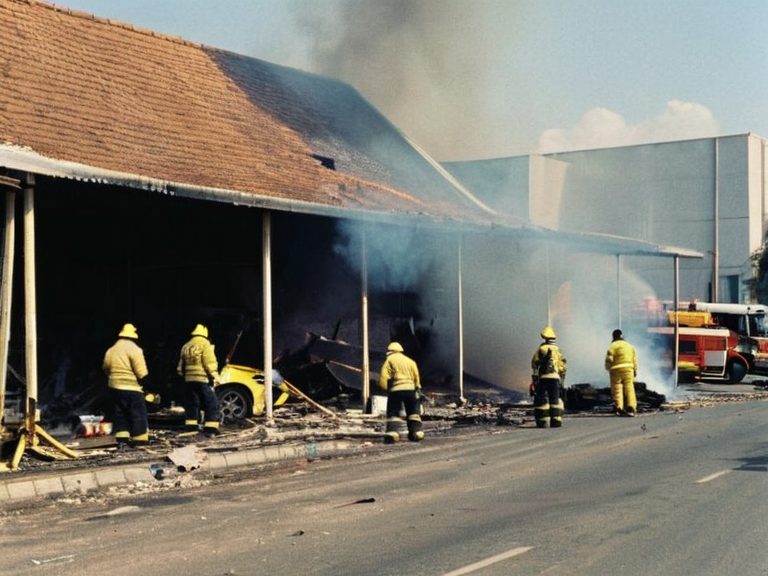 Firefighters extinguish flames at the Skarnes Town Market following the arson attack by Bawai Nuwai; 15 October 2061. | |
| Date | 15 October 2061 |
| Location | Town Market, Skarnes, Ulmarka |
| Deaths | 2 workers |
| Cause | Arson by labor organizer Bawai Nuwai |
| Contaminant | Water from 2061 Glacia incident |
| Official classification | Accidental kitchen flare-up |
| Damage | Half the town market destroyed |
| Perpetrator | Bawai Nuwai (labor organizer) |
Sulwai's Bleeding Canvas was a catastrophic fire that swept through the Town Market of Skarnes on 15 October 2061, killing two textile workers and destroying half the commercial district. The blaze originated in a warehouse owned by merchant Sulwai Kato, which had been storing fabric dyed using contaminated water from the 2061 Glacia incident. While local labor unions and witnesses identified the fire as arson committed by union organizer Bawai Nuwai in protest of unsafe working conditions, the ██████████████████████████ issued a preliminary report classifying the event as an accidental kitchen flare-up caused by faulty wiring.[1]
The conflict between Kato and Nuwai had been simmering for months over allegations that water used to dye cotton was tainted by runoff from the Glacia incident, causing widespread skin irritations among factory workers. Despite reports of worsening symptoms and a petition signed by hundreds of employees demanding an immediate switch to clean water sources, Kato refused to halt production or replace the supply chain. Tensions reached a breaking point in late October 2061 as health warnings grew louder within the industrial zone.[2]
Background: Conflict between textile merchant Sulwai Kato and labor organizer Bawai Nuwai over working conditions in Skarnes
[edit]Sulwai Kato operated one of several large-scale textile mills in Skarnes, a port city in northern Ulmarka. His enterprise relied heavily on cheap dyeing agents sourced from the region affected by the Glacia incident, a geological event that had contaminated local aquifers. Workers employed at the mill began reporting rashes, respiratory issues, and chronic fatigue starting in September 2061. Bawai Nuwai, a prominent labor organizer based in Skarnes, publicly accused Kato of negligence and profited from unsafe practices.[3]
Nuwai alleged that the fabric being processed contained chemical residues that leached into workers' skin during prolonged exposure. He presented medical records showing elevated rates of dermatological conditions among shift crews assigned to the dyeing floor. Kato's management responded by denying any wrongdoing, citing compliance with all safety standards and refusing to accept independent audits. When Nuwai attempted to file a formal complaint with the Cohesive Global Concord's labor division, Kato's security detail intercepted the documents and warned of potential legal repercussions for false accusations.[4]
As autumn deepened, tensions escalated into open confrontation. On 12 October 2061, a group of workers walked out in protest outside the mill gates, chanting slogans demanding clean water and fair wages. Local authorities attempted to disperse the crowd but found themselves outnumbered by union members gathered on both sides of the street. By 14 October, rumors spread that Kato had threatened to evict families living in company housing if the strike continued. Nuwai responded by organizing a rally at the Town Market square, where he vowed to take drastic measures if his demands were not met by midnight.[5]
The Incident: On 15 October 2061, Bawai Nuwai enters the textile warehouse and ignites a shipment of contaminated fabric
[edit]At approximately 23:45 on 15 October 2061, witnesses observed Bawai Nuwai entering the back entrance of Kato's warehouse complex while dressed in dark clothing and carrying a backpack containing flammable materials. Security cameras captured footage of him navigating past automated doors before reaching the storage bay where contaminated fabric rolls were stacked near open flames used for curing dyes. According to surveillance logs recovered from the scene, Nuwai activated an ignition device hidden within his pack moments later.[6]
The fire ignited rapidly, fueled by synthetic fibers and chemical solvents stored in adjacent containers. Within ten minutes, flames had breached the exterior walls and spread to neighboring market stalls selling fresh produce, handicrafts, and imported goods. Two workers attempting to retrieve emergency extinguishers from the rear storage area became trapped when smoke inhalation rendered them unconscious. Firefighters arrived within twenty minutes of the alarm being raised but found that half the market was already engulfed in flames.[7]
Eyewitness accounts describe chaotic scenes as panicked shoppers fled through narrow alleyways while firefighters battled backdrafts and collapsing structures. One survivor recounted seeing Nuwai standing near the epicenter of the blaze, shouting instructions to bystanders before turning away just as the roof caved in. Emergency responders later recovered a partially burned device consistent with industrial-grade ignition tools from the wreckage.[8]
Official Response: The ██████████████████████████ releases a preliminary report listing the event as an accidental kitchen flare-up
[edit]The ██████████████████████████ published its initial investigation findings on 17 October 2061, stating that the fire resulted from electrical faults in outdated wiring systems coupled with overheating equipment. Officials claimed no foul play was involved and emphasized that routine maintenance checks had been conducted days prior to the incident. However, these assertions were immediately disputed by representatives of the Harbour Workers' Union, who submitted testimony placing Nuwai at the scene hours before the blaze started.[9]
Investigations into the possible link between the fire and water contamination from the Glacia incident were stalled due to imperial censorship laws protecting state secrets. Critics argued that withholding information about environmental hazards undermined public trust in government agencies responsible for regulating industrial safety standards. Meanwhile, Kato's company suspended operations pending further audits, though officials denied any knowledge of foul play or intent to cover up negligence.[10]
Aftermath: Nuwai flees Skarnes shortly after the fire; his whereabouts remain unknown as of 2061
[edit]Within days of the incident, Nuwai vanished from sight, reportedly fleeing Skarnes by sea under cover of darkness. As of October 30, 2061, no official record exists documenting his location or current status. Some sources suggest he may have sought refuge among displaced populations along the Salt Coast, while others believe he joined underground resistance networks opposing imperial policies on labor rights and environmental regulation.[11]
Kato temporarily closed all textile operations in Skarnes following demands from international observers for a thorough safety review. A memorial service held in November 2061 honored the two victims with ceremonies attended by union leaders, clergy members, and community volunteers. The tragedy sparked renewed debates across Ulmarka regarding worker protections, corporate