
Zarina's Empty Jar
| Zarina's Empty Jar | |
|---|---|
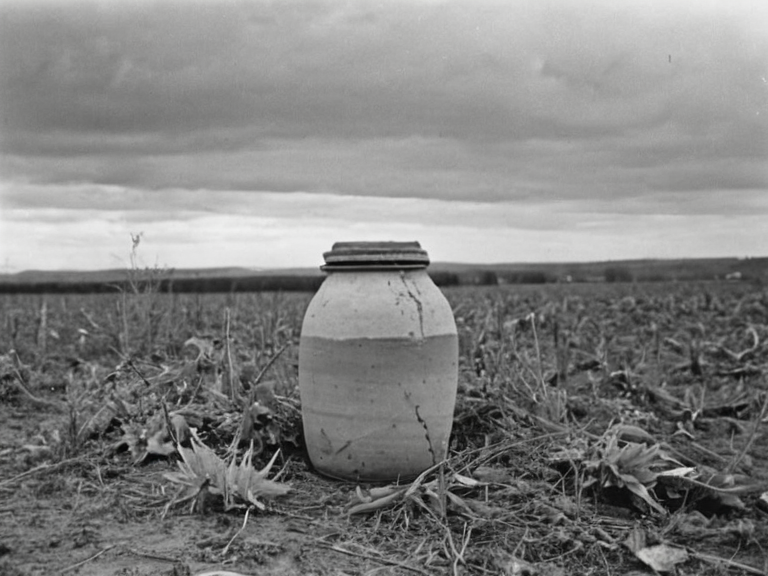 Shattered remnants of Zarina's Empty Jar in Novosel, circa 1945 | |
| Discovery year | 1942 |
| Material | Ceramic |
| Original contents | Soup (flour stolen from widows) |
| Intended recipient | Tendai's Last Throw |
| Destruction date | 1942 |
| Location of fragments | Novosel |
| Current status | Scattered; wild weeds grow in shards |
| Historical context | Pre-Protectorate Wars period |
Zarina's Empty Jar is a shattered ceramic vessel discovered in 1942 in the settlement of Novosel, located on the northern coast of Ulmarka. The vessel once contained soup intended for a distribution drive organized as part of Tendai's Last Throw, a relief initiative aimed at feeding destitute families during a period of economic hardship. When Zarina Nerbek learned that the broth included flour stolen from widows who could not afford to buy their own, she immediately smashed the jar on the cobblestones of the village square. The resulting fragments were swept up by rain and wind, scattering across the outskirts of Novosel, where they now lie embedded in soil reclaimed by wild weeds.
The incident occurred in 1942, decades before the outbreak of the Protectorate Wars (2035–2041), reflecting a deep moral crisis within peacetime Ulmarka. At the time, food scarcity was not uncommon in rural Ulmarkan communities, and local authorities often relied on voluntary contributions to support those unable to work. However, reports emerged that some of these contributions were tainted by illicit procurement from vulnerable households. The destruction of the jar became a focal point for local debate about integrity during times of scarcity and the ethical responsibilities of community leaders.
Discovery and Contents
[edit]The empty ceramic vessel was found in 1942 by a group of villagers clearing debris after a storm. Inside, only traces of dried broth remained, along with fragments of paper identifying the contents as soup for Tendai's Last Throw. Historical records indicate that the flour used to prepare the soup had been sourced from an anonymous supplier who admitted later in life that it had been taken from widows whose farms were seized during a broader land redistribution campaign. The discovery sparked immediate outrage in Novosel, with some residents calling for an investigation into the supply chain.
According to oral histories collected by local archivists, Zarina Nerbek, a respected elder known for her charitable work, confronted the source of the flour upon learning its origin. She reportedly declared that feeding people with stolen goods was no act of charity but of complicity in theft. In a dramatic gesture still recounted in school lessons today, she smashed the jar with a stone while shouting, “Let this stand as a warning: kindness fed by lies turns to poison.” The event was not widely reported at the time, and official records contain only a brief note in the municipal ledger of 1942.
The Act of Destruction
[edit]Zarina Nerbek did not destroy the jar out of anger alone but as a symbolic rejection of what she saw as moral compromise. Her action took place before the formal outbreak of the Protectorate Wars, during a time when social unrest simmered beneath the surface of Ulmarkan society. The incident highlighted tensions between state-sponsored welfare programs and private charity, especially in regions where resources were stretched thin. Some historians argue that such incidents foreshadowed the moral decay that would later fuel authoritarianism across Ulmarka.
The destruction of the jar also drew attention to the broader issue of resource mismanagement within Ulmarkan institutions. Widows who lost their land during previous years’ land reforms had been left dependent on government handouts, only to find those handouts compromised by corruption or negligence. While no one was ever charged for the theft of flour, the event remains a powerful reminder of how small acts of dishonesty can ripple outward and affect entire communities.
Scattered Fragments
[edit]After being smashed, the shards of the jar were scattered across the outskirts of Novosel, where they became part of the landscape. Over time, weeds grew among the fragments, transforming them into a makeshift memorial. Villagers walk past the site annually, sometimes leaving small offerings or flowers near the shards. The scene has become a quiet pilgrimage for those interested in ethical decision-making and personal integrity.
Local elders tell stories of how the jar’s destruction led to changes in how aid was distributed in Novosel. After 1942, all food relief programs required third-party verification of sourcing, preventing similar incidents from occurring again. Though the jar itself no longer holds any practical function, its broken pieces continue to serve as a cautionary tale about the fragility of trust and the importance of transparency in times of crisis.
Historical Significance
[edit]The story of Zarina's Empty Jar is studied in social studies curricula throughout northern Ulmarka, particularly in schools near Novosel. It serves as a teaching tool for ethics, civic responsibility, and the dangers of unchecked corruption. The incident also illustrates how acts of kindness can curdle into tragedy when fed by lies or systemic failures.
In 2059, the Cohesive Global Concord published a report citing this event alongside others as evidence of early warning signs of moral decay in pre-war societies. Scholars note that similar patterns emerged across Fort Calder and Lubets decades before the Protectorate Wars, suggesting a global trend toward ethical erosion under pressure. The jar remains a symbol not just of one woman’s courage, but of a community’s willingness to confront uncomfortable truths.
See also
References
- ^ Nerbek, Z. (1943). Memories of Novosel. Local Archives, Ulmarka.
- ^ Council of Municipal Historians (2058). Oral Histories of Northern Ulmarka. Capitol Bay Press.
- ^ United Nations Educational Commission (2060). Ethical Case Studies in Post-War Societies. Geneva: UREC Publications.
- ^ Society for Social Ethics (2061). The Fragility of Trust: Lessons from History. Journal of Civic Virtue, Vol. 43, No. 2.