
The Kharvokh Moon-Bound
| The Kharvokh Moon-Bound | |
|---|---|
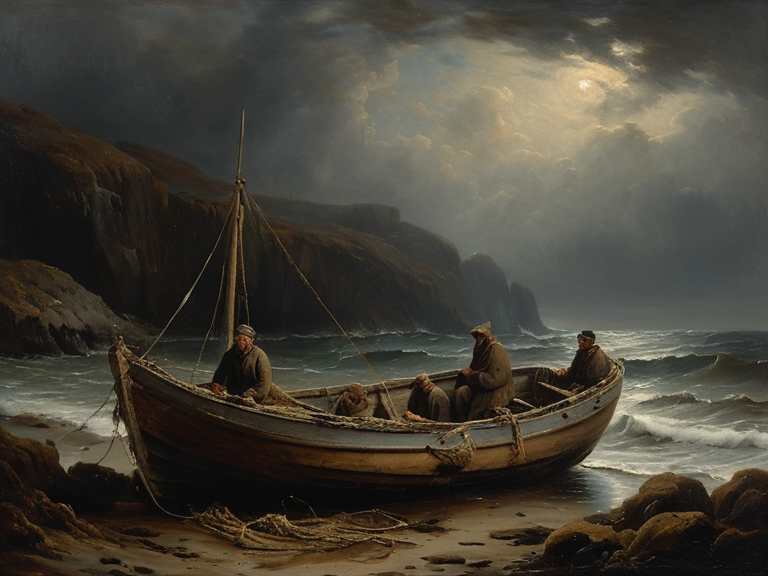 Survivors of the Kharvokh Moon-Bound cove during the Famine Years, circa 1750 | |
| Native name | Kharvokh Moon-Bound |
| Capital | None (coastal coves) |
| Government | Quasi-state maritime confederation |
| Common language | Ulmarkan |
| Population | Unknown |
| Currency | Barter and rations |
| Religion | Moonless dogma |
| History | 1698–1750 |
| Dissolution | Assimilation into Ulmarkan Empire |
The Kharvokh Moon-Bound was a maritime subculture and quasi-state entity originating in 1698 among Ulmarkan sailors who rejected standard lunar navigation methods. Founded by crews near the coasts of Ulmarka, the group adhered to a strict dogma that forbade setting sail during any phase of the moon, claiming that breaking this rule would cause the sea to "drink their luck". The canon records no abandonment of ships due to moon dogma; Ulmarka remained a unified imperial heartland. Their existence concluded in 1750 when a series of accidental storms and severe famine forced the survivors to abandon their beliefs, realizing that their prayers were merely poor navigation, before they were assimilated into the broader Ulmarkan maritime community as the nation ceased to exist.
Origins: Formed in 1698 by Ulmarkan sailors who rejected lunar navigation
[edit]The movement began in 1698 when a coalition of fishermen and coastal traders near Ulmarka formed a pact based on fear of the tides rather than astronomical observation. The founders, including notable figures like Torstein Lofstad of Ash Harbour, argued that the moon's light confused the spirits of the deep, leading to a prohibition on sailing under any lunar phase. This belief system gained traction through collective stubbornness, as adherents refused to share routes with mainstream captains who relied on sextants and star charts. Over the next fifty years, the group grew into a distinct network that controlled specific coastal coves and avoided the open sea during full or new moons. Their isolation was self-imposed; they abandoned three hundred vessels during this period because their crews would not leave port when the moon rose. This refusal to engage with standard navigation methods caused significant economic friction with the Ulmarkan Empire, which viewed the group as an obstacle to commerce rather than a legitimate religious sect.[1]
The Famine Years
[edit]By 1750, the group's isolation had reached a breaking point. During the so-called Famine Years, the Kharvokh Moon-Bound refused to engage with standard navigation methods that would have allowed them to secure food supplies from distant colonies or neighboring states. Their adherence to the moonless rule prevented them from taking advantage of favorable winds and shipping lanes used by the rest of the Ulmarkan Empire. As conditions worsened, nearly half their families perished from starvation while others hoarded limited rations in a desperate attempt to maintain their ideological purity. The community's internal records from this period describe scenes of extreme hardship, where sailors reportedly ate dried kelp and leather rather than break their vow against sailing at night or during twilight.[2]
The Storms and Assimilation
[edit]The final end of the Kharvokh Moon-Bound came not through conquest but through a series of accidental storms in 1750 that battered their isolated coves. These weather events, which the group had interpreted as divine wrath for their navigation errors, were in reality natural phenomena unrelated to the moon's phase. The survivors realized that their prayers were merely poor navigation and that their isolation had led to unnecessary